
Portland Piano International | Case Study
50% More Single-Ticket Buyers After Shifting to Video-First Marketing
The Organization
Portland Piano International (PPI) presents many of the top pianists in the world today — Lang Lang, Yuja Wang, Mitsuko Uchida, Angela Hewitt, Kirill Gerstein, Marc-André Hamelin, Boris Giltburg, and others — through its acclaimed Sunday “Timeless” concert series at Lincoln Performance Hall. Gold Sound Media has served as PPI’s marketing partner for nine years, an engagement that has evolved alongside the digital landscape itself.
The Challenge
For years, Gold Sound Media managed PPI’s full marketing operation — email campaigns to the subscriber list, print advertising, social media, and media relations, including press outreach to journalists covering the classical music beat. These tools worked. Subscribers renewed. The existing audience stayed engaged.
But traditional marketing has a structural limitation. Email reaches the list you already have. Print ads reach the readership that already exists. Media coverage — even well-placed features in respected outlets — reaches people who already consume those publications. None of these channels have a discovery mechanism. None of them put PPI’s world-class programming in front of someone who has never heard of the organization.
The question was not whether PPI’s marketing was effective. It was whether it could grow. In the 2022–23 season — the final season before the strategic shift — paid Sunday attendance averaged 333 seats per concert, with single-ticket buyers accounting for just 32% of the audience. The subscriber base was strong. The pipeline of new attendees was not.
The Strategy
Beginning in fall 2023, Gold Sound Media layered a video-first content and distribution strategy onto PPI’s existing marketing infrastructure.
The approach centered on short-form video — artist spotlights, performance highlights, and behind-the-scenes content — structured with hook-first openings, optimized for retention, and produced in format variety to prevent algorithmic fatigue. Each video was designed to capture attention in the first three seconds and hold it long enough for the platform to push it to new viewers — people outside PPI’s existing audience who would never have encountered the organization through email, print, or traditional media coverage.
Organic content served as the proving ground. The videos that performed strongest were then deployed as paid ad creative through targeted Meta campaigns, reaching precisely defined audiences at a fraction of what traditional advertising costs. This organic-to-paid pipeline ensured every dollar was spent behind content already proven to resonate.
The competitive advantage was not production — it was distribution methodology. Format variety, hook structure, retention optimization, and strategic paid amplification worked as a compounding system: each season built on the last.
The Impact
Sunday “Timeless” concerts at Lincoln Hall — before and after the video-first shift:
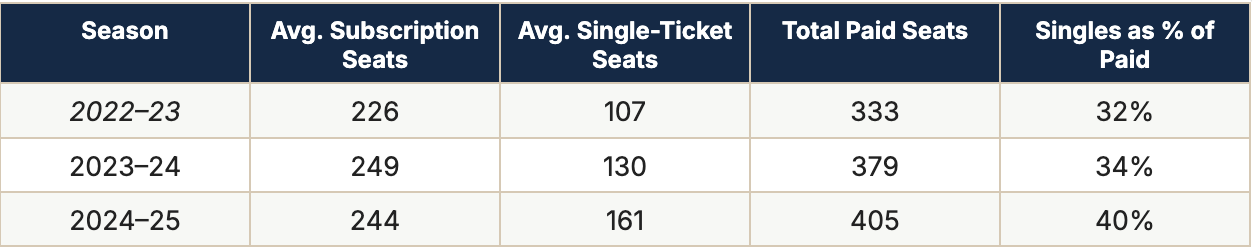
2022–23 = pre-video baseline. Video-first strategy began fall 2023. Data covers Sunday “Timeless” concerts at Lincoln Hall. Angela Hewitt’s performance (larger venue) excluded.
Two seasons after the shift (2022–23 baseline → 2024–25):
Single-ticket buyers up 50% (107 → 161 average per concert). Single-ticket growth is the strongest indicator of new audience acquisition, and this surge coincided directly with the shift to video-first marketing — the only significant change in PPI’s strategy during this period.
Total paid attendance up 22% (333 → 405 average per concert), driven primarily by single-ticket growth.
Singles as a share of paid seats rose from 32% to 40% — the audience composition itself shifted as new attendees entered the pipeline.
The digital infrastructure driving these results (2024 vs. 2025 calendar year):
Website sessions grew 22% (32,658 → 39,955), with social-driven sessions surging 61%. Video content was the primary traffic engine.
Organic social reach increased 18% and organic impressions grew 27%, even as paid campaign volume was intentionally reduced. The content was earning its own distribution.
Organic search sessions rose 28% — a secondary signal that increased digital visibility was driving broader discoverability beyond social platforms.
The Takeaway
Portland Piano International’s programming did not change. What changed was who saw it. Video-first marketing — layered onto existing operations and compounded across two seasons — expanded PPI’s reach into audiences that traditional marketing structurally could not touch. During that period, single-ticket buyers grew 50% and the organization’s audience pipeline broadened in ways that years of traditional marketing alone had not achieved.
What the Client Thinks
“Working with Jonathan Eifert is truly a joy. He understands the social media world (so I don’t have to!) while being a master at more traditional public relations skills. Within just our first year working together, Jonathan increased our organization’s visibility - setting up our first international press coverage! He is a master at creating the perfect tone in all modes of communication. We rely on him for his intelligence, connections and work ethic. We have never been disappointed.”
— Ellen Bergstone Wasil, former Executive Director, Portland Piano International